Showing posts with label mahabharat. Show all posts

Thursday, August 3, 2017

UP the land of super normal role models

Copyright@shravancharitymission


 In the complex understructure of India, UP sits like her invisible heart and spiritual voice. Stridently, a folklore and tradition champion. Indeed the most populated state that celebrates its lineage in its diversity. It has an irrefutable matrix of society that hails, from two major communities, the Hindus and the Muslims—both passionate lovers of their native.
    Even though, the expanse of Hinduism resonates much beyond India and goes right up to the global frontiers. UP has always been its formidable pillar in the ever lengthening axis. Rather, it has been the primordial hub of religiosity since time immemorial. If we deconstruct her, she expands to a vast region much before it was converted into administrative hedges like states and districts. Which, Gods loved and nature adored. So, one can say she has been the showcase, the playground and even the reliable archives of Hinduism since grand old times.
    She doesn’t require administrate boundaries to conjoin. As, she, connects, consolidates and even identifies herself in many other ways. To begin with it is the mix of Pancha Bhoota—where the elements of Prithvi (Earth), Jal (Water), Agni (fire), Vayu (air) and Akash (ether or the sky) combine for her cosmic creation.
    If we translate this into ground realities we find. Starting from the texture of the soil, to the pitch of the lingo it is one. It has no less than Gods and super humans, as its role models. To say, some of its role models are even better known than the land they belong to won’t be a misnomer. And they all performed their incredible leelas in this very soil. We will come to that a little later.
    UP has that enduring fix of festivals, with bucolic hand holding and even similarity in cereal crops to live and breathe in congruence. There is no life without water they say and water forms the lifeline of any society. To that effect there are vaguely a series of some six or seven imposing rivers, leaving aside many small ones that almost run parallel but certainly from the western side of the state to the eastern corner. And finally,   they all merge as tributaries with Ma Ganga. The main stem of Ganga, begins with the confluence of Bhagirathi and Alaknanda rivers in the town of Devprayag in Uttara Khand. And as per mythology she was brought to earth by king Bhagiratha, where, eventually she grew up to the status of Ma Janani in UP. She is indeed the queen mother of all the water bodies as she carries along with her all the rivers. Therefore, for certain she can be called the icon of motherhood and hospitality—an unbeatable role model again. So blessed is the state that there is hardly a district or a town that is not within the easy catch of a river. Where, inhabitants even identify themselves with the rivers, such as ‘Sarjupari’—person living across river Sarju. There are many annual melas that connect the rural fraternity and its vendors across the sub-regions like Ballia and Nauchandi mela, to name a few.
    Hinduism has four ashrams when it comes to completing a lifetime—Brahamcharya, (Balkal … Birth to student like), Grihasta (householder), Vanaprastha (retired) and Sannyasa (renunciation). The holy land of UP connects you to some quintessential examples of how some incarnations or avatars of Maha Vishnu have spent their time in these defined ashrams. Hinduism doesn’t come through, without UP. And all lessons of life are available here.
    It teaches us, nothing is easy and everything needs to be fought for, whether you’re an incarnation of God or just a human form. Even, when, Lord Krishna was the 8th incarnation of Maha Vishnu. Mathura was under turmoil the night little Krishna was born in Dwaparyuga (the 3rdYuga). He demonstrated the victory of good over evil when he killed his maternal uncle Kans. And by lifting the Goverdhan Parvat he proclaimed nothing is impossible if you are hell bent upon doing something. On bhakti (devotion) no one can beat Radha as a role model and it all happened in the Braj Bhoomi that is now divided into many districts. But Krishna leela has no boundaries.
    In the same land Bhagwan Sri Ram was born in Ayodhya as the 7th incarnation of Maha Vishnu in Treta Yuga (2nd yuga). Although, he was born before Krishna I’m describing him after Krishna because he had a steady childhood, whereas, Krishna had a fighting one. But Sri Ram exemplified himself as Maryada Purshottam—the quintessential example of respecting contemporary times and goodness accentuating to fairness. He had many mid life crises which he fought through valiantly all by himself and his devoted team. Prime was 14 years of Banvas (exile into forest) and the abduction of his wife by Ravana. Where, on the one hand he did show grief but on the other hand as a true karmyogi he found his bearings and organized himself to fight the great battle of Lanka to get his wife back. While doing so he ensured he didn’t overstep the tenets of science and its concomitants even, when, he was an avatar of Lord Vishnu. Today, Sri Ram is a household name and a role model that is not confined to any district or a religion and where his queen Sita is an epitome of devotion. His entire leela happened along the plains of river Saryu and the famous kingdom of Ayodhya where he ruled. Important to say—role models can be followed by any person from any religion or sect.
    Further, the great war of Mahabharat too, had its roots in Hastinapur near Meerut, again in UP. A well known mythological story, of intensely disagreeing and blood thirsty royal cousins, that eventually escalated into a holy war. It is said, what is not seen and read in Mahabharat doesn’t exist in the world. It has again given many role models to the world while it was fought in Dwaparyug. It had many stalwarts. Some important names that one can immediately reflect upon are Krishna, Yudhistir, Bhishma Pitamah, Dronacharya, Kripacharya, Kunti, Karan, Yudhistir, Bhimsen, Arjun, Nakul, Sahdev, Draupadi, Veer Abhimanyu to name a few.
    Krishna derives his umbilical and founding legacy from Braj Bhoomi. From where he goes on to recite those ultimate verses of Gita, that is destined to happen, only once-in-a-planet-time, to a tranced Arjun, challenging him to pick up arms and fight for righteousness. The heft of Krishna thus becomes so very onerous for any one human form to carry as a role model. Resultantly, he spends his life in the little fragments of his teachings to promote his cause.
    Post the battles of Lanka and Mahabharat you had those iconic—blazing writers and poets like Valmiki, Tulsidas and Ved Vyas capturing the vivid description of the proceedings that led to the deadly wars. Together with awesome description of the scenes of war that remain unparalleled even today.
    And going forward when it comes to Vanaprastha and Sanyas we have Varanasi to teach us how to approach retirement and death as a role model. People come to Varanasi to see live Hinduism and even to die. The pyre is ever lit in Manikarnika Ghat and they say if a person is cremated there he or she goes to heaven directly.
    It is one of the oldest ghats of Varanasi. It is revered in Hindu mythology that when Mata Sati, Lord Shiva’s wife sacrificed her life and set her body ablaze after Raja Daksh Prajapati, her father and one of the sons of Lord Brahma tried to humiliate her husband Shiva in the Yagya. Lord Shiva took her burning body to Himalya. On seeing the unending sorrow of Lord Shiva, Vishnu sent his divine Sudershan Chakra to cut the body into 51 parts which fell on earth. Lord Shiva established Shakti Peeth wherever Sati’s body had fallen. At Manikarnika ghat Mata Sati’s ornament had fallen. The lesson therefore is loaded with the despicable arrogance of king Daksh and the pristine relationship of Sati and Shiva—that can’t be emulated as a role model.
    In the treasured mythological scriptures such as Purans and Upanishads, battles between the Devatas (Gods) and Asuras (Demons) have often been described in great detail and on many occasions. Asuras, have always troubled Devatas for some reason or the other. In fact, they were mostly stronger than the Devatas in strength, and therefore Devatas were always scared of them. Even Devraj Indra who was extremely powerful and laced with a lot of divine offence could not harm them in any manner.  Many such wars were even fought, in an around, the present day UP.   Samudra Mathan (Churning of ocean) resulting into Kumbh, has also seen the bitter war between the Devatas and the Asuras for Amrit (Divine Nectar). Where, Lord Vishnu had to intervene. Because, had Asuras drank Amrit they would have become immortal, and that would have meant destruction of the goodness in the world.
    There are innumerable stories and one can go on and on. But the moot point is, whether, the present day generation of the state is living up to the values created by these role models.
*
By Kamlesh Tripathi
*
*
Share if you like it
*
Shravan Charity Mission is an NGO that works for poor children suffering from life threatening diseases. Should you wish to donate for the cause the bank details are given below:
NAME OF ACCOUNT: SHRAVAN CHARITY MISSION
Account no: 680510110004635 (BANK OF INDIA)
IFSC code: BKID0006805
*
Our publications
GLOOM BEHIND THE SMILE
ONE TO TANGO … RIA’S ODYSSEY
AADAB LUCKNOW … FOND MEMORIES
REFRACTIONS … FROM THE PRISM OF GOD
(CAN BE BOUGHT FROM ON LINE BOOK STORES OR WRITE TO US FOR COPIES)
*****


Friday, January 27, 2017

TO ABANDON A DEPENDENT IS NOT ACCEPTABLE EVEN FOR HEAVEN


Copyright@shravancharitymission

By Kamlesh Tripathi


DHARMRAJ YUDHISTIR’S RELIGIOSITY

    When, Maharaja Yudhistir came to know. That Sri Krishna has ended his jeewan-leela. And, post that. Yadav’s too, have undergone self-destruction, because of infighting. He decided to coronate Arjun’s grandson Parikshit as the king of Hastinapur, and head for sanyas. Keeping the difficult decision in mind, he started preparing for it. To begin with he decided to give up the prestigious and coveted king’s costume and its jewelry. Following, which, he decided to enter into a maun-vrat and unlock his hair. Finally, he entered into veer-sanyas and left his Raj Bhawan, and started walking towards the north. When, his brothers and even his wife Draupadi started following him.

    Yudhistir’s decision to renounce the world and it’s so called—moh-maya created ripples in his mind. As a result of which, he stopped eating food and drinking water. He even stopped resting his body and mind and refrained from looking at anyone, in the eye. And, decided to keep moving without stopping anywhere. Until, he crossed Badrinath in the Himalayas. Where, his brothers and even his queen Draupadi were pacing up with him.

        After crossing Satyapath, Yudhistir entered the divine land of Swarga-rohan. But by now his brothers and his queen were extremely exhausted and they fell sick. Soon Draupadi, Nakul, Sahdev and even Arjun—they all fainted one by one and fell on the ground. The weather was freezing in Himalayas. So they couldn’t revive themselves and soon attained Him-Samadhi. Thereafter, the divine powers of the holy land sent them to Swarg where they attained moksha. But, even, these stupendous calamities couldn’t stop Yudhistir. As, he, was continuously moving, and never looked back. Even to catch a glimpse of his brothers or his wife. He was now bereft of rag-dwesh. In the end, even Bhimsen, the strongest out of them, also collapsed and went into Him-Samadhi.

    When, Yudhistir was about to reach the top most mount of Swarga-rohan. He was not alone. In spite of the fact, that his brothers and his wife Draupadi, had gone into Him-Samadhi on the way. As, there was a dog, that was continuously following him, right from Hastinapur. When, Yudhistir finally reached the mount. Devraj Indra sat in his viman and descended on earth to meet him. He welcomed him and said—‘you’re the epitome of Dharma. So the swarg belongs to you. Please sit in my viman. So, that, I can take you there.’

    When, Yudhistir asked about his brothers and his wife Draupadi. And requested, that they, too, be taken to swarg. Devraj replied—‘they have already reached there.’

    To which, Yudhistir made another request—‘can we take this dog also in this viman.’

    Indra replied—‘you being the quintessential of dharma. Why do you talk like a novice? How can a dog enter swarg? Isn’t it enough that this desecrated being has had my darshan.’

    Yudhistir, wasn’t convinced by Indra’s logic. So he said—‘but the poor dog is dependent on me. Because of my devotion he has followed me all the way from Hastinapur. To renounce a living being that is dependent on you is adharma. So, deserting this dependent is not acceptable to me. And without him, I’m not willing to enter swarg.’

        Indra tried to counsel Yudhistir again—‘Rajan! You attain swarg only with the fruits of punya. Had, this dog been a punyatma. He wouldn’t have been born as a dog.’

    Yudhistir politely said—‘God if that is the case. Then, I would like to donate half my punya to this dog.’

    ‘Dhanya ho, dhanya ho Yudhistir! I am very happy with you. And discarding the dog form, the Dharm-Devta appeared in front of him and blessed him.
    Moral of the story: Think thousand times, before you abandon someone who is dependent on you.

Story is from Mahabharat

GLOSSARY

-         Maharaja—Great king

-         Jeewan-Leela—mortal role

-         Sanyas—life stage of renunciation within the Hindu philosophy

-         Maun-vrat—avow to remain silent

-         Veer-sanyas—renunciation from exercising strength

-         Raj-bhawan—official residence of king

-         Moh-maya—all things in the world are not real; they are fallacy, a presumed reality of the world held by people.

-         Dharmacharn—good virtues

-         Him-Samadhi—meditative trance

-         Swarg—Heaven

-         Moksha—released from the cycle of rebirth

-         Rag-Dwesh—love and hate

-         Viman—mythological flying palace or chariot described in Hindu texts

-         Dharma—eternal law of cosmos

-         Darshan—divine audicience

-         Adharma—going against the law of cosmos

-         Punyatma—blessed soul

-         Dhanya ho—be blessed

-         Dharm Devta--God

*****

Tuesday, December 13, 2016

MAHABHARAT- DRAUPADI'S PARDON

Copyright@shravancharitymission

By Kamlesh Tripathi


    Draupadi’s make shift tenement was filled with shrills and bloody echoes of wail. The holy war of Mahabharat had just about ended. In which Pandavas had had a thumping victory. But in spite of all this, there was a frightening and lasting lament in Pandava’s camp. But no one exactly knew why? When suddenly, Pandavas ran towards the chamber of Panchali from where these hell cries were coming.

    The scene was truly gruesome. As there lay dead, the severed heads of all the five sons of Draupadi in a pool of blood. That was even smeared on their torso. Dharmraj Yudhistir couldn’t bear the scene when he whimpered, ‘Draupadi … its heart rendering.’ And beyond that he couldn’t utter a word. Perhaps, with these few words, his unqualified agony together with surprise and inquisition, all came alive in one go.

    Upon witnessing the gory scene, Gandeevdhari Arjun’s shoulders started twitching. He couldn’t control himself, and yelled in anger—‘except for that morbid devil Ashwaththama. Who else could have carried out this ghastly crime? Wipe your tears Devi. As I enter into a pratigya, that I will make this rogue prostrate at your feet. I will squash him with my legs, so that you can bathe with his blood.’ And then Arjun requested Krishna to be his charioteer. He then wore his armour and lifted his Gandeev and charged after Ashwaththama. Clean-handed Pandavas were now listless, at the brutal murder of their sons. They were now getting wild and ferocious and wanted revenge forthwith. Under the circumstances, scared Ashwaththama couldn’t have remained out of their clutches for long.

    Arjun was beginning to get restless. He asked, ‘Madhusudhan, what should we do with this rogue? How should we punish him?’ And, before, he could even completed his sentence, Lord Krishna in an angry tone reacted—‘Parth! A rascal Brahmin’s execution, alone, is the way out. And this was your vow too. So, where is the question of any permission in this?’

    But while grieving on her dead sons, when Draupadi saw Guruputra Ashwaththama tied in ropes and lying in the room. She stood up and started pleading for mercy with Arjun—‘Prannath! Please forgive him.’

    But Arjun remained adamant. He said, ‘Draupadi sit on his chest—I want you to bathe with his blood.’

    Draupadi continued beseeching in her gruff timbre. She folded her hands to namaskar Ashwaththama and then addressed Arjun—‘Aryaputra! Ashwaththama happens to be the son of the same hallowed person from whom you have learnt superior war skills. He is also a Brahmin and therefore respectable to Chatriyas. And his mother Kripi is even alive today for the sake of her motherhood, where she sees her son Ashwaththama as her only motive in life and doesn’t follow her husband anymore. Nath! Also, my sons won’t return to life even if Ashwaththama is sent to the gallows. The way I’m weeping for them. His mother too will weep for him, and God only knows what else she might do. In case I can’t give happiness to someone, why should I be the reason for his sorrow?’

    Arjun, along with all his brothers was watching this amazing scene of morality being spelt out by Draupadi. Standing on the side was Bakenbihari in his usual manner in a calm posture. He slowly came forward and sarcastically said—‘what happened Arjun, why have you stopped? Come on lift the sword.’

    Arjun bowed at Lord Srikrishna and said—‘Madhav please pull me out of this dharmsankat’

    Srikrishna as if testing Arjun’s patience said—‘I am once again repeating my orthodoxical tenet to you. And, mind you. I am repeating it for your benefit alone parth!—Not to kill a fallen Brahmin, but to kill a miscreant—this alone is the ultimate dharma.’

    Arjun was spellbound for a moment. But he was a celebrator of wisdom and knowledge. And for him, as if this golden, primordial hint was enough. He acted forthwith. By pulling out the mani embedded in Ashwaththama’s forehead and thereafter tonsuring him. He then left him to wander as an insulted Brahmin who is like a dead person.

    Thus without killing the Brahmin, Arjun gave Ashwaththama punishment equivalent to death and fulfilled his pratigya.

Glossary
Panchali – another name of Draupadi
Gandeevdhari- the bearer of bow—Arjun
Devi – Divine Draupadi
Gandeev - Bow
Pratigya- Vow
Madhav/Bakenbihari/Madhusudhan-  Another name of Lord Krishna
Parth- One who doesn’t miss his target. Name given to Arjun by Lord Krishna
Prannath- Lord of life
Namaskar- Hindu greetings.
Aryaputra - Noble prince.
Nath- Lord.
Dharm sankat- moral ambiguity
Mani-jewel

    Extracted from Srimad bhagwat puran.


*****


Thursday, December 1, 2016

LORD KRISHNA'S RASLEELA SHOULD NOT BE EMULATED

Copyright@shravancharitymission

By Kamlesh Tripathi


    Most Gopis (radha and her sakhis) in their previous lives were great female Rishis (Sage). They were extremely proficient in the study of Vedas. When, Sri Krishna was earlier born as Lord Ram in Ayodhya, all the Rishis wanted to have sensual pleasure with him. Lord Ram had then given a vardaan (blessing) that when he is born as Krishna he will fulfill their wishes. Therefore, to have sensual pleasure with Sri Krishna was an old time wish of the Gopis. And for making Sri Krishna their husband they even went up to Devi Katyayani. There are many such examples like this that establish the fact of Sri Krishna’s supremacy. He was certainly not tied down to the systems and procedures of the physical and mortal world. To bless his devotees in various life situations he used to undertake various jobs and roles. But he could do this only because he was the supreme force. Ordinary and common people should only follow the great teachings of Lord Krishna as spoken and written in Bhagwad Gita. They should never imagine or dare to imitate Krishna by doing the raasleela (Dance of divine love).

    If Sri Krishna could perform raasleela, he could also lift the Goverdhan mount with his little finger. Or he could even kill the ferocious female demon Pootna which was not possible by any ordinary human being. And he had that supreme might to carry out such tasks. Such instances only decorate his personality. In the same manner even raasleela was an uncommon task, that couldn’t have been performed by an ordinary person. Mythology says even Arjun kept doing his duty as advised by Sri Krishna to keep him happy. Doing his duty alone was in his prowess even when Arjun was a great warrior. Krishna desired he should fight his enemies for the sake of mankind which he did to please him. First Arjun was not ready to fight. But later when Krishna exhorted him he changed his mind and decided to fight. Ordinary people only need to follow righteousness and Dharma in the form of karma. They should not abandon their karma at any cost. And by trying to emulate raasleela they are only inviting their own disaster. In the same manner Lord Shiva after Samudra Manthan (churning of the sea) drank the poison that came out of it. This was in the interest of humanity and since then his throat went blue. But if an ordinary person drinks poison to copy Shiva he will surely die.

    So it goes without saying. Whatever Sri Krishna did with the Gopis in the raasleela was on account of the age old Vardaan that carried no personal benefit for him.


*****

Saturday, August 13, 2016

Special significance of number 18 in Hindu scriptures

Copyright@shravancharitymission

By Kamlesh Tripathi


    Number 18 unquestionably has a great significance in Hindu scriptures. Apart from the fact that there are 18 Purans, 18 major Up-purans, and 18 Dharm-Shastras, the importance of number 18 is best explained in the great epic of Mahabharat, which is divided into 18 parvas or sections. The great war of Mahabharat was fought with 18 divisions of army. And out of this 11 were on the side of Kauravas and 7 on the side of Pandavas. The war lasted for 18 days. Finally, it is said that only 18 persons survived the war. The treatise Shrimad Bhagwad Gita is a part of Mahabharat and has 18 chapters. In Gita, Lord Krishna describes the ideal man in 18 verses at the end of Chapter 2, in which he lists the 18 traits that constitute the man with a steady wisdom.

    The central theme of all scriptures of all religions in the world are the same: prime being the victory of the higher being over the lower being, or righteousness over unrighteousness, of good over the evil, of dharma over adharma. Ved Vyas originally titled Mahabharat as Jaya (victory). The word Jaya is in the opening stanzas of both Mahabharat and Gita.

    In the Katapayadi-System (numerical notation system) of Sanskrit numerology each letter has a formula-based numerical value, where the numerical value of the word Jaya is 18. To stress on the importance of the word Jaya the number 18 is given a prominent place not only in Mahabharat, but also throughout various Hindu scriptures. The number 18 is thus repeatedly used as an auspicious reminder to be alert in our constant battle for inner spiritual victory.


 (taken from Hindu scriptures)

*****

Saturday, July 2, 2016

STORY: MAHABHARAT- DRONACHARYA AND EKLAVYA

Copyright@shravancharitymission


By Kamlesh Tripathi


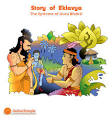
    Once while Dronacharya was imparting astra-shastra (Astra- is a fierce form of mantra that comprises of destructive frequency. Shastra- is essentially a physical weapon) knowledge to Kurukul children—Kauravas and Pandavas in Hastinapur, one day a black and tough appearing Bheel (tribal) child came up to him. He first bowed and said pranam (greetings) and then said—‘Acharya! (teacher) my name is Eklavya. I have come with the hope that you will be kind enough to teach me astra management, as you are teaching these children.’

    Acharya appreciated the humbleness in the child; but he couldn’t have given permission to a Bheel to stay with the Rajkumars (princes). He therefore said—‘Son! For knowledge of weapons to hunt animals you can ask your Guru, but as far as learning of astra is concerned it is not a must for you, as the same is required only when you have to rule a kingdom or fight a war.’

    Upon hearing this Eklavya was disheartened. But his enthusiasm had still not died down. He was determined to learn astra-shiksha. So somewhere there only and not far from Dronacharya’s gurukul (residential school) he built a cottage and along with that he also made a bust of Dronacharya and established it in front of his cottage. And thereafter with his bow and arrow he started vigorous practice.

    One day Dronacharya along with his shishyas was roaming around the jungles, when a dog of Pandavas by mistake dawdled away to where Eklavya was practicing his targets in full flow.     The dog at the frightful sight of a dark and tough Bheel with a bow and arrow started barking. This spoiled Eklavya’s concentration and to stop the dog from barking he filled it’s mouth with arrows but without piercing it.   This frightened the dog so much that he immediately retracted and ran towards Pandavas. 
   
    On seeing the dog both Pandavas and Kauravas laughed at its condition, but Arjun was immensely surprised. He realized someone had immaculately aimed the arrows in such a manner that none of the arrows had pierced its mouth, even when his mouth was completely packed with those arrows. And it was evident that the arrows were shot by some very proficient archer. Acharya Dronacharya was also stunned and immediately decided to discover this wondrous archer.

    Meanwhile, when Eklavya saw Dronacharya, he rushed towards him to pay his respects. On seeing his bust in front of the cottage Dronacharya was stunned. But just then Arjun who was right behind him slowly whispered in his ears—‘Gurudev! You had given a word that amongst all your shishyas I will be the topmost archer; but in front of him I look petty. Now how will you protect your own word?’ Upon hearing Arjun’s comment Achraya tried to reassure him. He then decided to demanded guru-dakshina (tradition of repaying one's teacher or guru after the period of study) from Eklavya; and when Eklavya asked—‘Acharya what can I do for you that will make me blessed?’ Acharya hesitatingly replied—‘You need to give me the thumb of your right hand as guru-dakshina.’

    Eklavya who was otherwise matchless in strength and a stalwart suddenly turned patient. He heard his guru and then took out his sword and cut his right thumb and placed it near his feet. After losing his thumb he had ceased to be an ace archer and by performing the skill with his left hand he wouldn’t have been in the list of top archers of his times. But because of his sacrifice and unquestioned loyalty towards his guru Dronacharya he became immortal in the annals of mythology.

    There is no mention about how Dronacharya must have felt receiving Eklavya’s thumb as guru-dakshina. And at that moment did he feel small? But yes, ultimately he blessed Eklavya to immortality.


*****

Monday, June 6, 2016

ARTICLE: BOLLYWOOD BETWEEN DIAMOND AND PLATINUM JUBILEE

Copyright@shravancharitymission

By Kamlesh Tripathi


Bollywood between diamond and Platinum jubilee  
Remake: epic serial ‘Mahabharat’ starring superstars

    ‘Bollywood’ is the sobriquet for the Hindi film industry based out of Mumbai. The term is also loosely used as a synecdoche to refer to the whole of Indian cinema. It has made millions and trillions through cinema and has a huge Indian following and the same has now even rippled abroad. It has been in existence for more than eighty five years now. Raja Harishchandra was the first silent feature film made by Dadasaheb Phalke in 1913. By 1930s, the Indian Film Industry was producing over 200 films per annum. And ever since then it has never looked back. It is one of the largest film producers in India, representing 43% of net box office revenue, while Telugu and Tamil cinema represent 36% and the rest of the regional cinema constitutes 21% as of 2015. It is also one of the largest centers for film production in the world and it is formally referred to as ‘Hindi cinema’ and is one of the biggest movie industries in the world in terms of the number of people employed and the number of films produced in 2011, over 3.5 billion tickets were sold across the globe which in comparison is 900,000 tickets more than Hollywood.

    Hitherto Bollywood has functioned quite enviously under different banners for more than eighty five years and has given us some wonderful movies. But it is about time it now comes under one united banner to give India the entertainment of a lifetime—the real dhamaka of the century.

    Bollywood missed the lifetime occasion of a diamond jubilee celebration and platinum is still far away, but by then many superstars of today may hang their boots. So now is the right time to produce a mega serial where all the diggajes of Bollywood can come together and act, and for the sake of Bollywood’s commemoration they should act free. And if we delay it further we may miss out on many such great actors coming together as they may call it a day. The idea is to make them act together in a mega project which may not be possible in a three hour movie. I would therefore suggest a remake of the great epic ‘Mahabharat’ which is still the most popular serial ever made in Indian history.

    Imagine how would you feel watching Mahabharat scripted by the all time famous duo of Saleem-Javed as was done in Sholay, music by A.R Rehman, songs by Lata Mangeshkar, Asha Bhonsale, Anuradha Podwal, Anup Jalota and Bhupendra (unfortunately Kishore and Mukesh are no more) and my caste to name a few would be: Amitabh Bachchan as Bheeshma Pitamah, Nana Patekar as Dronacharya, Anupam Kher as Mahatma Vidur, Ajay Devgun as Krishna, Amir Khan as Karan, Shahrukh Khan as Yudhistir, Salman Khan as Bheem, Kritik Roshan as Arjun, Ranbir Kapur as Nakul, Abhishek Bachchan as Sahdev, Javed Jafri as Shakuni, Danny as Dhritrasth (ideal would have been Amrish Puri but sad he is no more), Jaya Bachan as Gandhari, Shabana as Kunti, Priyanka Chopra as Draupadi.

    These are only few names and characters with my limited knowledge and once you start detailing it many more icons will surface to take on many more challenging characters of Mahabharat.

    But will this ever happen? Well nothing is impossible and the way we like watching Mughle-Azam even after half a century and Sholay even now, this serial if ever produced shall be watched for time immemorial.


*****