Showing posts with label short story. Show all posts

Monday, May 14, 2018

BOOK TALK: THE BET ... by Anton Chekov


Copyright@shravancharitymission


THE BET
by Anton Chekov
Khidki (Window)
–Read India Initiative—
This is only an attempt to create interest in reading. We may not get the time to read all the books in our lifetime. But such reviews, talk and synopsis will at least convey what the book is all about.
    Anton Chekov, was a Russian playwright and a short-story writer. He was considered to be the greatest, among the writers of short fiction in history. His career as a playwright produced four classics. His best short stories are held in high esteem by many renowned writers and even critics. Chekov all his life practiced as a medical doctor along with his illustrious literary career. ‘Medicine is my lawful wife,’ he once said, ‘and literature is my mistress.’
    ‘The Bet’ is an 1889 short story by him about a banker and a young lawyer who enter into a bet. To, decide what is better death penalty or life in prison.
    The story opens with the banker reminiscing the occasion, of the bet some fifteen years ago. The guests at that party that he was hosting that day fell into a discussion of capital punishment. The banker argued that capital punishment is more humane than life imprisonment. Where, the young lawyer disagreed. Insisting he would choose, life in prison rather than death. So, to, arrive at a conclusion. They agree to a bet of some two million roubles. Thinking the lawyer won’t be able to spend fifteen years in solitary confinement. Thus the bet was struck. When the lawyer cast’s himself into isolation, for fifteen years.
    The man spends his time in confinement reading books, writing, playing piano, studying, drinking wine and educating himself. One finds him growing intellectually throughout the story. We see various phases in his term of imprisonment over the years. At first, the lawyer suffers from serious loneliness and depression. But soon he begins vigorous studies. About languages and other related subjects. Then, he ventures into a mix of science, literature, philosophy and some other random subjects. Further, he ends up reading some six hundred volumes in the course of four years. Then the Gospel followed by theology and histories of religion. In the final two years, the imprisoned lawyer reads immensely subjects of chemistry, medicine and philosophy and at times works of Byron or Shakespeare.
     In the meantime the banker’s fortune declines. He all of a sudden realises that if he loses the bet, paying off the debt will leave him bankrupt.
    So, the day before, the fifteen-year period concludes. The banker resolves to kill the lawyer so that he doesn’t have to pay him the money. And on his way to do so, the banker finds a note written by the lawyer. The note only declares that during the time of his confinement. He has learned to despise material goods as fleeting things and he believes that knowledge is worth more than money. Therefore, he elects to renounce the reward of the bet. The banker is moved and shocked to his bones after reading the note. He kisses the strange man on the head and leaves the lodge weeping, relieved not to have to kill anyone. The prison warden later reports, that the lawyer has left the guest house. Thus losing the bet but proving his point that solitary confinement is more humane than death punishment as it gives a chance to a person (the lawyer in this story) to develop himself. The lawyer also unwittingly saves his own life by writing the note.
 CHARACTERS
    The lawyer is seen to be persistent, intelligent and self motivating. He doesn’t break down in the 15 years of imprisonment as the banker had foretold. He is intelligent by the virtue of reading so many books, which reflects on his eagerness to associate with other men, rather than claiming the final prize. He starts as a young impatient person, ready to spend 15 of his best years of life for 2 million roubles. His character of being a person with no interest in materialistic luxury is reflected when he renounces the 2 million and settles with just having proved his point.
    Whereas, the banker likes to be in a position of authority. Where, he likes to wield power over others. Especially those, who happen to disagree with him. The character changes drastically from the beginning of the story when he seems to be very free handed as he easily bets to pay two million. But later, lack of wealth drives him to dishonesty and a plan for murder. This also signifies the weak character of the banker. He is very attached to the materialistic luxuries of life and values human life less than his luxuries. So he plans to kill the lawyer for money and nothing but money changes his mind.
By Kamlesh Tripathi
*
*
Share it if you like it
*
Shravan Charity Mission is an NGO that works for poor children suffering from life threatening diseases especially cancer. Should you wish to donate for the cause. The bank details are given below:
NAME OF ACCOUNT: SHRAVAN CHARITY MISSION
Account no: 680510110004635 (BANK OF INDIA)
IFSC code: BKID0006805
*
Our publications
GLOOM BEHIND THE SMILE
(The book is about a young cancer patient. Now archived in 7 prestigious libraries of the US, including, Harvard University and Library of Congress. It can also be accessed in MIT through Worldcat.org. Besides, it is also available for reading in Libraries and archives of Canada and Cancer Aid and Research Foundation Mumbai)  
ONE TO TANGO … RIA’S ODYSSEY
(Is a book on ‘singlehood’ about a Delhi girl now archived in Connemara Library, Chennai and Delhi Public Library, GOI, Ministry of Culture, Delhi)
AADAB LUCKNOW … FOND MEMORIES
(Is a fiction written around the great city of Nawabs—Lucknow. It describes Lucknow in great detail and also talks about its Hindu-Muslim amity. That happens to be its undying characteristic. The book was launched in Lucknow International Literary Festival of 2014)
REFRACTIONS … FROM THE PRISM OF GOD
(Co-published by Cankids–Kidscan, a pan India NGO and Shravan Charity Mission, that works for Child cancer in India. The book is endorsed by Ms Preetha Reddy, MD Apollo Hospitals Group. It was launched in Lucknow International Literary Festival 2016)
TYPICAL TALE OF AN INDIAN SALESMAN
(Is a story of an Indian salesman who is, humbly qualified. Yet he fights his ways through unceasing uncertainties to reach the top. A good read not only for salesmen. The book was launched on 10th February, 2018 in Gorakhpur Lit-Fest. Now available in Amazon, Flipkart and Onlinegatha
(ALL THE ABOVE TITLES ARE AVAILABLE FOR SALE IN AMAZON, FLIPKART AND OTHER ONLINE STORES OR YOU COULD EVEN WRITE TO US FOR A COPY)
*****

Thursday, December 29, 2016

THE GOOD MAN

Copyright@shravancharitymission

By Kamlesh Tripathi


    Once upon a time there lived a rich person who had built a huge temple in his hometown. He had kept one poojari there (Hindu temple priest) to perform, the daily puja of God. And, to meet the expenses of the temple, he had transferred his assets, such as, land, farms and even his orchards in its name. He had done some meticulous planning and organized the whole thing in such a manner. That, for all the devotees coming to the temple; those who were hungry or in pain, or any other person who was poor or even a sadhu (sage). Could have, stayed there for a couple of days. He could have eaten the prasad (devotional offering of food made to God) from the temple as his meal. And after putting all these wonderful ideas in place, he was now on the lookout for a manager. Who could well handle the temple property along with its systems and procedures in an efficient manner.

    Many candidates came to the rich man for the job. They all knew. That if they are selected as the manager of the temple. They will get a good salary. But the rich man rejected everyone. He told them—he required only a good man. And, that, he’ll be able to find one himself.

    On this unbecoming behavior of the rich person, people starting abusing him discreetly. Some even started calling him simpleton and mad. But, the rich man did not pay any heed to what anyone said. When the temple used to open in the morning and people used to line up for darshan (auspicious sight). He used to climb up to his terrace. From where, he used to quietly watch all the devotees who came for darshan. One day a quintessential person came to the temple. His clothes were torn and dirty. He didn’t appear to be well educated. He had his darshan after which he was about to leave. When the rich man called him to his house and asked—‘Sir! would you like to work as the manager of this temple?’

    The man was rather surprised. He said—‘I’m not very educated. So, I, really don’t know, how I’ll be able to handle the management of this huge temple?’

    Rich man said—‘I don’t want a very educated manager either. I’m just looking for a good man. Who could become the manager of this temple.’

    The man politely replied—‘My dear brother. In this sea of human beings around the temple, what made you feel. That I am the sole good man around?’

    Rich man mildly elucidated—‘I know you are a good man, because this pathway to the temple had a pointed edge of a stone jutting out. And for many a days now, I was watching it. Many people had hurt themselves because of it. People used to fall because of it. Then they used to get up and just go away. But you were different. You were not hurt with that stone. Yet, considering, someone else might get hurt. You decided to pull it out. I was watching you, when you called for the shovel from my labour. Only to take the trouble of digging that stone out. Thereafter, you leveled the area for others comfort and safety.

       The man responded—‘that is nothing. In fact, it is every man’s duty to remove thorns, pebbles and even stones, stuck in the ground that might hurt someone.’

    To which the Rich man confided—‘people who are clear about their duties and who believe in performing it alone are good men.’

    The man was appointed the manager of the temple. Where, the rich man was not wrong, because the man administered the temple in a very efficient manner.
   

*****

Wednesday, October 12, 2016

SHORT STORY: NO FOOD IN HEAVEN UNLESS YOU DONATE DURING YOUR LIFETIME

Copyright@shravancharitymission

By Kamlesh Tripathi


    In the country of Vidharbh there ruled a king by the name of Shwet. He governed his country in a very meticulously manner and his subjects were quite happy under his rule. But after a period of time the king was not enjoying all this. He felt like giving up his kingdom, and move to vairagya (renunciation). Soon, he decided to hand over the reign of his empire to his brothers, after which he left for the jungles to perform his tapasya (austere meditation). The passion and devotion with which he had governed his country all this while, prompted him to even perform his tapasiya in the same manner, and it continued for a thousand years. During that period the devotion he showed was incomparable. He was therefore sent to Brahmlok (where Lord Brahma resides) after his death. There he had all the facilities, but he never got any food to eat. And out of hunger, his senses had debilitated. When he finally couldn’t bear it, he asked Lord Brahma, ‘God!—Brahmlok is considered to be free from the pangs of hunger and thirst. But, then, why is it that I’m almost dying of it.’

    Lord Brahma replied—‘Vatsya! (Dear) In Mritulok (world of life and death) you never donated for a noble cause. Neither did you feed any hungry person. And unless you donate and feed the needy in Mritulok you will never get food in Bhramlok. The food you ate while you were alive only nourished your own body. Therefore, you can go back to Mrityulok and continue to feed on your dead body. There is no other way out for you. Your dead body shall remain there forever as your food. And after hundred years, Agasta Muni (sage) will rescue you from this state.’

    After hundred years Agasta Muni with his power of dev-yoga reached that huge jungle of hundred yojan (vedic measure of area). It was completely quiet. There was neither an animal nor a bird in it. At the centre of that jungle there was a lake. Near that Agasta Muni saw a corpse lying. He started wondering whose corpse is it and how did the person die. In the meanwhile there landed an aircraft from the sky in the lake. From that a divine looking person came out. He first entered the lake to have a bath. After which he started feeding on the corpse lying there. And after filling his stomach sumptuously, he had a good look at the face of the corpse and then started moving towards his aircraft to return to Brahmlok. Muni asked him—‘You appear to be a divine person from heaven, but your food is obnoxious.’ The dead person then told his entire story to the Muni and said, ‘my hundred years of punishment are over. But I don’t really know when I’ll get to see Agasta Muni, and, when, will he rescue me.

    Agasta muni replied—‘Divine Soul! I am Agasta Muni. Tell me, how can I help you? The divine person said –‘Since I never presented anything to anyone in my life. I want to present you with this valuable ornament. Kindly accept this and help me out.’ And the moment he accepted the ornament the corpse vanished and the divine person attained complete moksha.

    Remember if you are in a position to help someone and you don’t, it is a crime.

From Padam Puran, shristi khand

*****

Monday, September 26, 2016

A FRIEND'S ADVISE

Copyright@shravancharitymission


By Kamlesh Tripathi


    Durga was a rich farmer, but a very lazy one. Who, neither looked after his fields; nor his granary. Nor did he ever bother to keep a regular count of his cattle. That apart, he did not even bother to look after his household belongings. Anything and everything, he just left it on his servants to accomplish. But his laziness soon led to mismanagement. When, the situation at home became adverse. Where, he started losing money, both in his farms and even in his dairy.

    One day, Harish, a friend of Durga, came visiting him. He noticed the situation in his house to be extremely deplorable. But knowing well, Durga won’t accede to his valuable sermons.  He decided to play a noble trick. To help him tide over the situation, he said—‘Friend! I’m disheartened to see you in such a deplorable condition. But I have a sure shot and an easy way to pull you out of your miseries.’

    Durga was now eager to know what his friend wanted to say. He politely requested—‘kindly tell me know what you have in mind. I’ll surely follow.’

    Harish said—‘my dear friend, before all the birds wake up in the morning. A white swan that lives Mansarovar lake comes to earth and returns by noon. One can’t exactly say when he comes. But it is generally believed. That anyone who is able to have his darshan is considered very lucky. For you’ll have no problems in life thereafter, and also, you’ll roll in riches.’

    Durga replied—‘Is it. Then, come what may, I’ll ensure I have his darshan.

    After the conversation, Harish left for his home. Next day, Durga got up early in the morning. He came out of his house, in pursuit of the white swan, and walked towards the granary. There he saw one person pilfering grain out of his heap. When, he saw Durga coming. He started apologising.

    From the granary Durga returned home. Then he went to his cow ranch. There he saw his milker, milking his cow. But to his surprise, he was only filling his wife’s pot with the milk. Durga scolded him. Thereafter, he had something to eat. And then he left his home again. In search of the white swan, when he went to his fields. There, he noticed, his labourers had not reached the fields. He patiently waited for them. When they finally arrived he reprimanded them for coming late. And in this manner, wherever he went, he curtailed his losses.

    Thereafter, in search of the white swan, Durga started getting up early in the morning every day, and started roaming around. With the change in his habit, his servants started working properly. All the pilferage stopped in his granary and even in his cow-ranch. Earlier, he used to be a sickly person, but now he had become healthy one because of his long walks. The fields from where he was getting poor yields had suddenly started giving high returns. And his cow-ranch too started giving milk aplenty. That gave him rich dividends.

          One day after a long time, Durga’s friend Harish came to his house again. When, Durga said—‘friend! I couldn’t find that white swan you spoke about last time; but in his pursuit I started making profits.’

    Harish started laughing, when he replied—‘friend! To toil relentlessly, is the white swan, I was talking about. The wings of labour are always white. People, who don’t work and leave everything to their servants, always suffer losses. But, people who toil themselves, and look after their servants, earn fortunes and respect.
*******


Friday, July 22, 2016

THE TWO MAJOR HISTORICAL EPICS IN HINDUISM- WRITTEN BY VALMIKI, TULSIDAS AND VED VYAS

Copyright@shravancharitymission

By Kamlesh Tripathi


    Had it not been for the ultimate epic writers and sages such as Valmiki and Tulsidas who wrote Ramayan, and Ved Vyas who wrote Mahabharat Hinduism would have remained incomplete and perhaps in the confines of God alone. And it is only because of these great all time writers that the history of Hinduism has spread so comprehensively across the world since inception.

    Ramayan and Mahabharat are the two historical sagas referred as Itihas (history) in Hinduism that serve as eternal inspiration for humanity and is considered as the putative and exemplary realization of the four … purusharthas (efforts): Dharma (righteous and dutiful) Artha (wealth) Kama (desire and fulfillment) and Moksha (liberation).

    Ramayan in real sense is the ‘abode of Lord Ram’ and is smaller of the two great works. The tireless epic mirrors the highest ideals of Hindu tradition, culture and civilization. The story relates to Treta Yug (one of the four ages of the world) and centers on Ram, the prince of Ayodhya an incarnation of Lord Vishnu, and his wife Sita, the incarnation of Mother Lakshmi. Ramayan sings the glory of Lord Ram and advises humanity on how to lead a fulfilling life and attain the four purusharthas. The epic is profound and timeless in its popularity and teaches, with the use of symbolism, how an individual can evolve to greatness and perfection.

    Sage Valmiki’s Ramayana has been translated into most Indian languages, as well as several foreign languages, including Russian. It consists of 24,000 stanzas in seven cantos, and depicts Rama as the ideal king, son, brother, friend, and husband. In Bharat, Lakshman, and Shatrughan, we see exemplified ideal brothers. In Sita, we have the purest flower of Indian womanhood, who is devoted to her Lord in thought, word, and deed.

    Ramayana is an ideal textbook of morals and values that inspires nobler dimensions of character and conduct. Other noteworthy and famous versions of Ramayana include Sage Veda Vyasa’s Adhyatma Ramayana, Goswami Tulsidasa’s Shri Ramcharitamanas (Tulsi Ramayana), and Kambar’s Kamba Ramayana.

    Mahabharata is an epic that is more than eight times the size of Homer’s Iliad and Odyssey combined, and in philosophical content is unparalleled to any other literary work in the world. This grand book of knowledge contains more than 100,000 stanzas in 18 chapters and is the work of the renowned Sage Veda Vyasa.

The underlying theme of Mahabharata is yato dharma tato jayah, “where there is dharma, there is victory,” indicating the ultimate triumph of good over evil and the establishment of righteousness.

The story unfolds toward the end of Dvapara Yuga, and describes the genealogy and events leading up to, and after, the familial war between royal cousins.

    The story is used as a vehicle to convey eternal philosophical truths of the highest order. It is said, “That which is in Mahabharata can be seen elsewhere, but that which is not therein cannot be seen anywhere else.” This gives an idea of the comprehensiveness of subjects in the epic, which is full of lofty instructions on all aspects of human life and endeavour—an inspiring saga of India’s past glory, portraying all that is great and noble in humanity.

    The guiding spirit throughout the epic is the divine figure of Lord Krishna, who brings the pure and the righteous to Himself, and who destroys evil and evildoers. Shrimad Bhagwad Gita or the “Lord’s Song,” is part of Mahabharata.


*****

Saturday, July 2, 2016

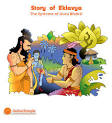
STORY: MAHABHARAT- DRONACHARYA AND EKLAVYA

Copyright@shravancharitymission


By Kamlesh Tripathi


    Once while Dronacharya was imparting astra-shastra (Astra- is a fierce form of mantra that comprises of destructive frequency. Shastra- is essentially a physical weapon) knowledge to Kurukul children—Kauravas and Pandavas in Hastinapur, one day a black and tough appearing Bheel (tribal) child came up to him. He first bowed and said pranam (greetings) and then said—‘Acharya! (teacher) my name is Eklavya. I have come with the hope that you will be kind enough to teach me astra management, as you are teaching these children.’

    Acharya appreciated the humbleness in the child; but he couldn’t have given permission to a Bheel to stay with the Rajkumars (princes). He therefore said—‘Son! For knowledge of weapons to hunt animals you can ask your Guru, but as far as learning of astra is concerned it is not a must for you, as the same is required only when you have to rule a kingdom or fight a war.’

    Upon hearing this Eklavya was disheartened. But his enthusiasm had still not died down. He was determined to learn astra-shiksha. So somewhere there only and not far from Dronacharya’s gurukul (residential school) he built a cottage and along with that he also made a bust of Dronacharya and established it in front of his cottage. And thereafter with his bow and arrow he started vigorous practice.

    One day Dronacharya along with his shishyas was roaming around the jungles, when a dog of Pandavas by mistake dawdled away to where Eklavya was practicing his targets in full flow.     The dog at the frightful sight of a dark and tough Bheel with a bow and arrow started barking. This spoiled Eklavya’s concentration and to stop the dog from barking he filled it’s mouth with arrows but without piercing it.   This frightened the dog so much that he immediately retracted and ran towards Pandavas. 
   
    On seeing the dog both Pandavas and Kauravas laughed at its condition, but Arjun was immensely surprised. He realized someone had immaculately aimed the arrows in such a manner that none of the arrows had pierced its mouth, even when his mouth was completely packed with those arrows. And it was evident that the arrows were shot by some very proficient archer. Acharya Dronacharya was also stunned and immediately decided to discover this wondrous archer.

    Meanwhile, when Eklavya saw Dronacharya, he rushed towards him to pay his respects. On seeing his bust in front of the cottage Dronacharya was stunned. But just then Arjun who was right behind him slowly whispered in his ears—‘Gurudev! You had given a word that amongst all your shishyas I will be the topmost archer; but in front of him I look petty. Now how will you protect your own word?’ Upon hearing Arjun’s comment Achraya tried to reassure him. He then decided to demanded guru-dakshina (tradition of repaying one's teacher or guru after the period of study) from Eklavya; and when Eklavya asked—‘Acharya what can I do for you that will make me blessed?’ Acharya hesitatingly replied—‘You need to give me the thumb of your right hand as guru-dakshina.’

    Eklavya who was otherwise matchless in strength and a stalwart suddenly turned patient. He heard his guru and then took out his sword and cut his right thumb and placed it near his feet. After losing his thumb he had ceased to be an ace archer and by performing the skill with his left hand he wouldn’t have been in the list of top archers of his times. But because of his sacrifice and unquestioned loyalty towards his guru Dronacharya he became immortal in the annals of mythology.

    There is no mention about how Dronacharya must have felt receiving Eklavya’s thumb as guru-dakshina. And at that moment did he feel small? But yes, ultimately he blessed Eklavya to immortality.


*****

Thursday, June 23, 2016

Copyright@shravancharitymission

By Kamlesh Tripathi


PARMESHWAR VS THE PRIDE OF DEVTAS

    Once there was a war between Devtas (Demigods) and Asurs (Demons). And in that war by the grace of Supreme God Almighty Devtas achieved victory. Asurs who perpetuated in destroying the decorum of God Almighty and the religious scriptures lost in this war. Albeit, this great victory was because of the blessings of God Almighty, Devatas could somehow not comprehend the real reason for their victory. They thought it was purely because of their own power and might, and that no one else had anything to do with it. But Supreme God Almighty did not lose time in understanding the arrogance of Devtas. And, to put down their false pride he soon appeared in the form of a supercalifragilisticexpialidocious Yaksha (broad class of nature-spirits, usually benevolent, who are caretakers of the natural treasures hidden in the earth and tree roots.)

    Devtas could not understand this quaint form of God, looking like a Yaksha and were awe struck. They sent Agni-Devta (Fire-demigod) to find out about Yaksha. When Agni reached there, Yaksharoop (God in form of Yaksha) asked him, ‘who are you?’ Agni said—‘you don’t know me. I’m famously known in the world as ‘Agni-Devta.’ Yaksharoop then asked—‘You call yourself famous and powerful—but what kind of power do you yield?’ Agni replied, ‘I have the power to burn the entire universe into ashes.’ Upon hearing such arrogant words from Agni Yaksharoop kept a small straw in front of him and said—‘kindly burn this.’ Agni tried but couldn’t. He tried again and again but failed each time. And finally in anger he burst into flames from his toe to his head, yet he couldn’t burn the straw. In the end he got extremely frustrated and embarrassed and returned where he came from and told the Devtas, ‘I couldn’t find anything God like in that Yaksha.’ It was a blatant lie.

    Thereafter, Devtas decided to send Vayu-Devta immediately to check on Yakshaswaroop. But he again asked, ‘who are you and what kind of power do you possess? Vayu-Devta replied, ‘In this entire universe I’m known as Vayu-Devta. I’m almighty and with my power I can make anything in this universe fly.’ At this Yakshaawaroop pointed towards the same straw lying on the ground and asked him to fly it. Vayu-Devta utilized all his strength but could not even move it by an inch and in the end filled with shame he too returned to the Devtas. When devtas enquired, ‘what happened, could you find out who this Yaksha is?’ he sadly replied, ‘I couldn’t?’

    Finally Devtas politely requested Devraj Indra, ‘God! You alone can delve deep in this matter regarding Yaksha?’ Indra-Devta acceded to their request and said, ‘very well’ and left to meet Yakshaswaroop but before he could even reach him he had disappeared from there. But noticing the devotion and inquisition with which Devraj Indra had come, Bhagwati Goddess Uma suddenly appeared in front of him. Indra asked, ‘Mother! Who is this Yaksha?’ Bhagwati Uma replied, ‘This Yakshaswaroop is the Supreme God Almighty. You may not know, but only with his blessings and lilashakti (divine mesmerization) Asurs were defeated in that great war that you fought, and let me tell you, Devtas only had a minimal contribution in that great victory, but you all were not aware of this and dwelled in false pride and arrogance. And, therefore, only to smash the destructive pride in you Devatas, Supreme God Almighty has emerged in the form of Yaksharoop. You all need to understand that in this universe the might of the warriors, the strength of the mighty, the enlightenment of the litterateurs, the meditation of tapasawis (Sages in deep meditation) and the energy of the energetic; all of this comes only from only one source and that is the Supreme God. And through his divine plays emerges the righteous powers of which you get only few droplets. He is the nerve centre of all the happenings in the universe and he alone is the ruler of the universe in the real sense. And therefore priding about oneself is only misleading.’

    Bhagwati Uma’s words were an eye-opener for Indra-Devta. He was embarrassed on his mistake and the mistake of other Devtas. And after returning he narrated the actual reason of their victory and that made all the Devtas realize their false pride and that in turn made them happy.

*****

Thursday, June 16, 2016

HOUSE WIFE OR A CAREER WIFE

Copyright@shravancharitymission

By Kamlesh Tripathi


    Savita looked a little restless when her husband, who was new in a job, introduced her as a ‘housewife’ after three of his junior colleagues introduced their wives as ‘career-wives’ in the office gathering that was partying around the annual target achievement ball. Savita later tried to dilute her introduction by talking more about her academic career than her career as a homemaker. But it got me thinking while I was standing in a corner. What is the future of and Indian housewife?

    Oxford dictionary defines a housewife as a married woman, whose main occupation is caring for her family, managing household affairs and doing housework: the traditional division of labour between the husband as breadwinner and wife as housewife.     Chambers on the other hand defines housewife as a woman who looks after the house, her husband or partner, and the family, and who often does not have a paid job outside the home. Merriam Webster describes a housewife as a married woman who is in charge of her household. But in urban India we generally refer, a housewife as gharwali, a person who manages the house but doesn’t have a career. And in converse a husband is called a gharwala, but he bloody well has to go out and make a career.

    But, tables have turned in India now where things have really opened up for women especially in the urban areas. Be it education, skill development, entrepreneurship and the works. Traditionally, Indian women were tied to their homes and families as part of family tradition and also because there weren’t too many opportunities. But India has moved on since then and there exists ample opportunities now for them to create their own identity in the Indian workforce of 500 million strong, and where 60% of Indian population is below 35 years of age and each ear 10 million jobs are required to keep the young Indian population afloat . So then the big question is will the 21st century woman in all her vanity and egomania love being called a housewife or a career wife?

    India loves following the west. So let’s take the American workforce per se. It comprises of 47% female workers and 53% male workers (a close race) and therefore Supermom is not a myth after all, and Super Dad is beginning to become a realty in India (Vodafone campaign).

    Last but not the least will the existing housewives (now mothers) of India prefer their daughters being addressed as a housewife or a career wife and what about the husband—a housewife or a career-wife and what about the wife—a house-husband or a career-husband?

*****


Thursday, June 2, 2016

STORY: GOD LIKES SIMPLE WAYS

Copyright@shravancharitymission

By Kamlesh Tripathi


    Once, the head of a Bheel (tribal) community by the name of Bheelkumar Kannap landed up in a temple located in a remote jungle after hunting.

    Temple housed an idol of Lord Shiva. And upon noticing the idol of Shiva in a degraded state Kannap got a little emotional. He was simple at heart and felt—‘Shiva is alone in this jungle with countless wild and notorious animals. Hope no animal comes in the night and attacks him.’ By now it was evening and obviously getting dark. Concerned about Shiva, Kannap loaded his bow with an arrow and decided to guard the temple by standing across the door, where he spent the entire night.

    At dawn, Kannap thought of doing puja in the temple; but truly speaking he didn’t know how to perform a puja. So he went to the jungle and killed an animal and roasted its flesh on fire for prasad. He then climbed a tree and broke open a honeycomb and collected honey. Thereafter he collected everything in a leaf-bowl and then plucked some flowers and stuck them on his unruly hair and plaits. He then filled his mouth with water from the nearby river and reached the temple to perform his puja. The idol had some dry leaves and flowers rotting around it. Kannap removed them with his feet; because his hands were tied up, because with one hand he was holding his bow and with the other he was holding the leaf-bowl filled with roasted flesh and honey. He washed the idol with the water in his mouth. And then he pulled out the flowers from his hair and started respectfully placing them in front of Shiva and thereafter he placed the leaf bowl in front of the idol. And in his simplicity he thought the puja is over, and then with his bow and arrow he started guarding the temple.

    In all of this Kannap forgot his home, his family, and so much so that he even forgot his hunger and his sleep. In his endeavour to safeguard his beloved God and performing the puja he as if forgot his world and his own self and even his body.

    But, surprisingly, in that very temple every morning, a Brahmin also used to come from a distant village to perform puja and after the ritual he used to go back. He normally came when Kannap was away in the forest, hunting. And on finding morsels of flesh in the temple the Brahmin was saddened. He walked up to the river and got some fresh water and cleaned the temple. And he bathed again to perform the puja. But this was not a matter pertaining to a particular day. When the Brahmin found the temple in this condition every morning he decided, ‘today I’ll hide and see as to who is this person who is polluting and soiling the temple every day.’

       Brahmin hid himself in the temple and started gazing to and fro from the camouflage. After a little while he was astounded to see a scary appearing bheel (tribal) carrying a bow and arrow on his shoulders. And after seeing him he did not have the guts to say anything. And when Kannap entered the temple he was shocked to see that one eye of the idol was bleeding. He slowly kept the leaf-bowl on the ground and started weeping—‘Who is this devil who has hurt my God in the eyes?’

    Immediately, Kannap loaded his bow with an arrow and ran out of the temple. He wanted to kill the person who had inflicted injury upon the idol; but he could find no one, soon he kept his bow and arrow on the side and started collecting some grass and leaves. And in a little while he had collected a heap. He then returned to the temple and started crushing the grass and the leaves that he had collected, and started applying it on the eyes of the idol. But even by doing so Kannap was not successful in stopping the bleeding. This made Bheelkumar Kannap extremely uneasy. But just then he remembered what another bheel (tribesman) had one told him—‘In the wound of a person if the same body part of a different person is placed then the wound heals immediately.’ Kannap was happy to remember it and he decided to act immediately. From his quiver he quickly pulled out an arrow and with that he scooped out his own eye even when it pained to the hilt and placed it on the eye of the idol and pressed it hard. And, from his own wound, from where he had pulled out his eye blood had started oozing out but he was unaware of the pain. On the contrary he was feeling happy that it had stopped the bleeding from the eye of the idol.

   But the agony was not over as just then the other eye of the idol too started bleeding. But Kannap by now had the therapeutic solution for it. He kept the toe of his foot on that eye of the idol, so that after he scoops his second eye and goes blind it will not be difficult for him to find the second bleeding eye in the idol. And with his arrow he scooped out his second eye. But before that suddenly there was divine illumination in the temple, and from the idol Lord Shiva emanated and embraced Kannap; and said,

    ‘Dear Brahmin! Puja and its complex methods don’t make me happy. What really, makes me happy is the earnest and respectful feelings of a devotee towards me.’ Lord Shiva addressed the Brahmin hiding there. And by now Kannap’s eyes had healed as that became Ashutosh’s (Shiva’s) prasad, and along with him he went to his divine abode. The Brahmin too because of Bheelkumar Kannap’s simple ways that God liked got darshan of Lord Shiva.

And that is why it is said, ‘it is so simple to be happy, but so difficult to be simple.’


*****

Thursday, May 26, 2016

ARROGANCE LEADS TO DESTRUCTION--LEARN IT FROM DURYODHAN

Copyright@shravancharitymission

By Kamlesh Tripathi


    Just before the commencement of the holy war—Mahabharat, Arjun broke down in the battle field and his emotions ran high when he was unable to come to terms with the prevailing circumstances, that soon he would have to fight his very near and dear ones—Kuruvansh who happened to be his first cousins, and where his main rival was Duryodhan. He was also in a state of torment when he saw Bhishma Pitamah standing stupendous right opposite to him, and ready to take him on, when in his cradle of arms he had spent his childhood. And flanked on the sides of Pitamah were his revered Gurus—Dronacharya and Kripacharya all tied down by various pratigyas (vows) to defend the Kuruvansh. And amidst all of this he was suppose to raise the battle cry to deluge them in the sea of destruction.

    And when Arjun was unable to withstand the emotional pressure, he looked up to Lord God Krishna who was his charioteer and entered into a conversation with him, who, sermonized Arjun to pick up arms against his close relatives and to fight for righteousness. Arjun responded to his mighty sakha (friend) Krishna, but desired to see his “Vishwaroop” (omni divine form) in order to get out of his tender spell to which Krishna obliged, and thereafter Krishna said to Arjun:

    Dear Arjun! I am pleased with you for you are my friend and bhakt (devotee) and therefore with my antarangaa shakti (inner strength) I was able to show you my Vishwaroop. For bear it in mind before you no one else in this universe has ever been able to see the aaseem tatha tajomaya aadi-roop of mine. And you would have realized my Vishwaroop was shinning like the sun and the faces in it were continuously changing like the cycle of birth and death. Krishna had revealed his omni-form to a composed Arjun.

    Before Arjun no one had ever seen the Vishwaroop of Krishna but when Arjun was shown this stupendous form of Krishna which was also scary in some ways, avatars and devotees from swarg lok (heaven) and people from other lokas too got a glimpse of it only because of Arjun. Conversely with the blessings of Lord Krishna all his disciples and followers were able to have darshan of his Vishwaroop that Arjun was witnessing.

    It is said when Krishna went to Duryodhan with the peace (sandhi) proposal before Mahabharat, due to sheer arrogance Duryodhan not only rejected the offer but also attempted to insult and imprison Krishna and at that time Krishna in extreme anger showed him some form of his Vishwaroop which was quite different than what was shown to Arjun, but unfortunately ignoramus Duryodhan in his haughtiness and false pride could not understand the divine message from Lord God Krishna otherwise the war of Mahabharat could have been averted.


*****

Friday, April 22, 2016

STORY: THE CORRELATION BETWEEN KARMA AND TAPASYA

Copyright@shravancharitymission

By Kamlesh Tripathi


THE CORRELATION BETWEEN KARMA AND TAPASYA
   
    It is widely believed that Hinduism is not a religion but a way of life, where one could continue to remain a Hindu even without really practicing it. But when you run through the religious texts it doesn’t say so, that simplistically. In fact, it won’t be a misnomer to say Hinduism is all about good and bad Karma—and ‘Karma’ alone is the essence of Hinduism. While Karma emanates from your mindset, tapasya (prolonged, intense and rigorous form of meditation) is the versatile vehicle of karma that takes you to your goal, and in case of any misdeeds it also acts as the penance, to pull you through tough times. Hence, once could say a ‘Tapasya’ in many ways is only a planned and focused karma.

    If you go through Hindu texts dispassionately you would find, there were no free lunches, not even for Gods. Everyone had to fight for each specific issue where opponents could not be taken for granted just because someone commanded a superior position, breed, hierarchy or a better brand. And, competitor intelligence then, was a vital strategy for survival. While one could continue in life, being an average and inactive person. But for Herculean, milestone and phenomenal achievements one had to go in for long and arduous tapasyas where even Gods were not spared from the drill.

    When Pandavas were exiled from their kingdom, Lord God Krishna advised Arjun to obtain Divyastras (divine weapons of various Gods) as that would have help Pandavas in the future, while combating the Kauravas. But Divyastras were not available off the shelf, even when Arjun was a very close sakha (friend) of Lord God Krishna. And for Divyastras the only way out was to perform rigorous tapasyas to please respective Gods to bless him with their weapon, which Arjun did successfully. Specific Devatas (God) had specific powers but, no, one, Devata had all the powers vested in her or him. Devatas on many occasions were even found weaker than asuras and danavs since power and might were never a constant factor, as mentioned in the famous and historic episode of Samudra Manthan (churning of the ocean) and so Devatas often had to perform long tapasyas to win over asuras. And asuras too were not behind in this, as they often performed mind boggling tapasyas to obtain vardans (blessings) which they used for destructive purposes.

    Ravan the king of Lanka had done a lifetime of tapasya and was well entrenched as a tall pundit but his tapasya was not followed by good karma and so all his knowledge went for a waste. So in Hinduism can not one say both karma and tapasya work in tandem? Good karma with intense tapasya will yield good results, while good karma with intense tapasya followed by bad karma will only dilute the effects of tapasya. And as long as the arch of good karma continues time shall be kind to you.

    Let me also tell you another story that will give you a flavour of how even Gods had to go in for intense tapasyas for specific events as no one had unlimited powers, and how at times they had to be interdependent  on each other to attain self goals by keeping aside their personal egos. And that is why it is said, it is extremely difficult to shoo the ego in us. And every person has his ups and downs in life where karma gives us the flexibility of adjusting to these ups and downs through the prowess of tapasya.

    Once when Lord Brahma (the creator of universe) was narrating a story to Rishi Narad he said,

    Dear Narad! Once when Prajapati Daksh left for Mandirachal Parwat (Mandirachal Mountain), I too decided to perform a difficult vrat (a religious practice to carry out certain obligations with a view to achieve divine blessings for fulfillment of certain desires) and started praying to Devi Jagbamba, wherein I repeatedly told her in my prayers what I wanted. When Jagdamba was pleased with my vrat she gave me darshan (divine audience). I bowed in respect and said ‘pranam Devi,’ she asked. ‘Tell me Brahman! Why have you been praying to me so passionately, and tell me soon.’

    On hearing this, I folded my hands and politely said—‘mother! A God named Rudra who happens to be an avatar (incarnation) of God Sadashiv has insulted me. So, I desire you take the form of Sati (Shiva’s first wife) and destroy his arrogance. Kindly take birth as Prajapati Daksh’s daughter to attract God Sadashiv towards you. Bhagwati! Barring you, there is no one else in this universe with the power to attract him erotically. And in anticipation that you’ll accede to our request, and so very excited to receive you as his daughter, Prajapati Daksh is already underway his intense tapasya in Mandirachal Parwat.

    On my saying so Bhagwati was shocked and surprised beyond words and she even looked worried. She said—‘what is this that you are saying Brahma ji? You want me to attract Lord God Sadashiv, and for this malicious job you’re seeking my help. Therefore, in reality whatever you’re doing is only Lord God Sadashiv’s criticism. And this is a big mistake. Everyone knows I cannot do anything against God Sadashiv. Tell me what will I gain by attracting the nirvikalp (that does not have an alternative) God Sadashiv, as I am only like his menial maid. And for the salvation of his devotees only he has taken the avatar of Rudra. Lord God Sadashiv is the undisputed emperor of all the three Lokas. He is also yours, and Lord Vishnu’s swami. Even in yoga, he is ahead of both of you. I am indeed astounded to hear this foolish thought coming from you, where Lord Brahma wants to captivate Lord God Sadashiv who happens to be the king of Maya (the supernatural power wielded by Gods and demons) and I am truly dumbfounded at this.’ And after saying this Devi Jagdamba went back to meditation, when she received a message from Lord God Sadashiv that without my blessings nothing happens. With my consent only Sri Brahma and Prajapati Daksh are in intense vrat and meditation. So give them the vardan and take birth in Prajapati Daksh’s family and I’ll accept you. Important: Even Lord God Sadashiv had to seek interpersonal help in a polite manner by requesting Devi Jagdamba.

     After receiving instructions from Lord God Sadashiv, Devi Bhagwati said, ‘Brahma ji—‘its fine. I will try my best, so that Lord God Shiva falls for me, and marries me as his second wife. As such there is no one in the world who can break Lord God Shiva’s concentration and attract him sensually, and even I don’t have this power and capacity. Nevertheless, I will endeavour to attract him after obtaining an avatar to fulfil your desire.’ And after this she disappeared.
    Meanwhile Prajapati Daksh was into deep and rigorous tapasya in Mandirchal Parvat. He kept meditating for three thousand years. In summers he used to meditate in the middle of fire and in severe winters he used to immerse himself in cold water, and in between tapasyas he also obtained proficiency in pranayam.  At last when Bhagwati was happy with his tapasya she gave him darshan.
     Bhagwati Shiva knew everything and so she said to Prajapati Daksh—I’m extremely happy with your tapasya and therefore you can ask for a vardan (blessings). Daksh with folded hands said—Devi! If you are happy with me then you please take birth in my family as my daughter, since Lord God Sadashiv has taken a new avatar in the name of Rudra as Brahma’s son, and there is no one to match him and therefore you too need to take an avatar to marry him. For in the universe there is no other person who can do this. Brahma ji for this very important work has sent me here to Mandirachal Parvat for a long-long tapasya. Now you also with your attractive maya (illusions) try and attract Lord God Sadashiv and oblige the world. Jagdamba said—‘it will happen in this manner only.’ From your wife’s womb I shall take birth as your daughter and to endear Lord God Sadashiv I will do intense tapasya. And after saying all this Bhagwati Shiva disappeared as she had a long to-do-list to be completed.
    Karma is the opportunity to do important things in life while tapasya the preparation and that alone differentiates between the Devata and the man.
*****